News from SHS
Actuality from the project
Launched in September 2023, this project draws on the humanities and social sciences to shed light on the origins of the planets and the emergence of life. In partnership with the CNRS, it is led by three partners: the Collège de France, the National Museum of Natural History, and the University of Grenoble-Alpes.
Collège de France
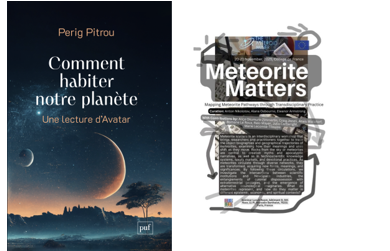
At the Laboratory of Social Anthropology, research is conducted on the cultural variation in representations of life, approached from the perspective of the “Anthropology of Life”—a field presented in 2024 in the book What Humans Do with Life; this comparative analysis is at the heart of the work How to Inhabit Our Planet. A screening of Avatar focusing on the portrayal of extraterrestrial life in film.
In addition to workshops at the Collège de France and the Maison Française d’Oxford on the themes of origin myths, the origins of life, and meteorites, ethnographic studies were conducted in Nepal and Japan on conceptions of life associated with “stones that fell from the sky.”
=> Featured in National Media
France Culture
Introduction to What Humans Do with Life, France Culture « La suite dans les idées », December 12th 2024. [https://www.radiofrance.fr/franceculture/podcasts/la-suite-dans-les-idees/anthropologie-de-la-vie-2334220]
“Avatar: A Lesson on How to Live Better on This Planet?”, Question du soir, France Culture, December 24th 2025. [https://www.radiofrance.fr/franceculture/podcasts/questions-du-soir-l-idee/questions-du-soir-l-idee-emission-du-mercredi-24-decembre-2025-5438257]
France Inter “Avatar: How Should We Think About the Planet’s Habitability?”, La Terre au carré, France Inter, December 16th 2025. [https://www.radiofrance.fr/franceinter/podcasts/la-terre-au-carre/la-terre-au-carre-du-mardi-16-decembre-2025-3885010]
Radio France Internationale
Presentation of What Humans Do with Life, Radio France Internationale, “Around the Issue”, January 28th 2025. [https://www.rfi.fr/fr/podcasts/autour-de-la-question-le-magazine-de-toutes-les-sciences/20250128-que-font-les-humains-avec-la-vie]
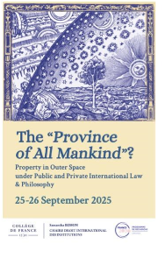
The Chair in International Institutional Law held its international conference, chaired by Prof. Besson, titled “The Province of All Mankind? Property in Outer Space under Public and Private International Law & Philosophy” (September 25 and 26, 2026; conference proceedings to be published in late 2026).
Media Appearances
Samantha Besson, Matinale de France Culture, December 30th 2025: https://www.radiofrance.fr/franceculture/podcasts/l-invite-e-des-matins/le-droit-international-peut-il-survivre-a-la-montee-des-guerres-2899442
Alban Guyomarch, Questions du soir, France Culture https://www.radiofrance.fr/franceculture/podcasts/questions-du-soir-le-debat/lancement-d-artemis-ii-faut-il-retourner-sur-la-lune-5919314
National Museum of Natural History
In collaboration with the Institute of Mineralogy, Materials Physics, and Cosmo-chemistry (MNHN), the Alexandre Koyré Center has undertaken a study of the history of the historical collections of the Museum’s Geology and Mineralogy Gallery, in order to better understand the scientific, political, and cultural implications of studying the origins of life and the Earth over the long term. This historical inquiry also examines how these issues have been represented in the public sphere and informs
a discussion on how to present the question of origins to contemporary audiences. Adèle Chevalier, a postdoctoral fellow recruited for the project, is exploring the historical evolution of the division between the life and earth sciences at the Museum since the 18th century, on the one hand, and the emergence of stromatolites as key objects for the scientific study of the origins of life, on the other.
Two books have recently been published on the history and challenges of visualizing the universe and the origins of life:
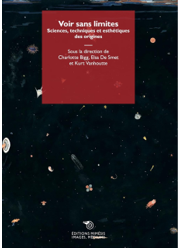
Charlotte Bigg, Kurt Vanhoutte, Elsa De Smet (dir.). Voir sans limites. Sciences, techniques et esthétiques des origines. Mimesis, 2025, Images, Médiums, 9788869763816.
Appearances in the national media:
Charlotte Bigg, chronique mensuelle ‘Retour sur image’, revue Pour la science, tout au long de l’année 2026
Florian Métral
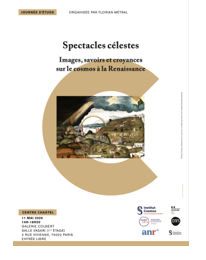
Within the dual framework of the project “Celestial Spectacles: Images, Knowledge, and Beliefs about the Cosmos in Early Modernity” (CPJ CNRS Arvigraph, 2024–2028), affiliated with the André-Chastel Center, and the project “The Writing of Origins: From the Ensisheim Meteorite (1492) and the Life of Stones in the Renaissance,” co-funded by the cross-cutting support program of the PEPR “Origins: From Planets to Life” (2025 grant recipient), several research initiatives are currently underway. These include, in particular, a doctoral dissertation on the Ensisheim meteorite, led by Allan Didot (co-supervised by Matthieu Gounelle, IMPMC), with initial results expected soon. This research has already led to an initial symposium titled “Celestial Spectacles,” held at the National Institute of Art History in May 2026, as well as the publication of a contribution in the catalog for the exhibition Extraterrestrial Art in the 21st Century (Mouans-Sartoux), offering an archaeological exploration of the concept for the Renaissance period (15th–16th centuries).
Several field studies are currently underway in Europe, focusing on a more specific theme: visual representations of life in cosmological conceptions of the modern era. This research is expected to lead to the organization of a second symposium in 2027 or 2028.
Also at the IMPMC, the “Anthropology of Life” team is launching an interdisciplinary exploration of conceptions of life developed in scientific laboratories. Following the model of a laboratory ethnography presented in Cyrille Jeancolas’s book Can Life Be Created in the Laboratory? (with a preface by P. Pitrou), a postdoctoral researcher, Clémentin Bouquet—co-supervised by S. Bernard and P. Pitrou—is conducting an interdisciplinary study on the concept of biosignatures in geology. In connection with a fieldwork and sampling mission carried out in Isua in 2025, the project is developing in two directions. A first experimental project is fabricating laminated mineral structures through evaporation: Characterizing these structures allows for a discussion of the criteria for identifying biological stromatolites. A second line of research analyzes articles on the rocks of Isua (Greenland) to examine the debates surrounding ancient traces of life.
Grenoble-Alpes University
At the Research Group on Communication Issues (GRESEC), a long-term seminar series on “science and communication” is being held at MSH Alpes.
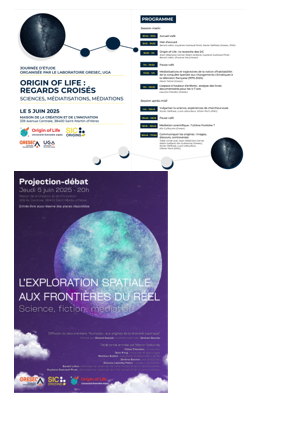
A study day, followed by an evening event open to the general public, was organized by GRESEC in collaboration with PEPR Origins and CDTool Origin of Life UGA:
“ORIGIN OF LIFE: CROSS-DISCIPLINARY PERSPECTIVES ON SCIENCE, MEDIA COVERAGE, AND MEDIATION” (June 5, 2025, Maison de la Création et de l’Innovation, UGA).
A doctoral student, Alexis Trémé, was recruited in 2025 as part of the project to conduct research on communicating the origins of Earth and life, from Earth to space.
Focus
Continue and complete the research subprojects, including those led by young researchers recruited as part of the project; symposia, fieldwork, and publications currently in preparation
Cultural Representations of LifeInterdisciplinary Definition of LifeHistory of CollectionsSpatial LawRepresentations of the Origins of Life in the Media
Relation with others WP
not applicable
Relation with industries
Not at the moment
Publication links to the project
Toutes les publications liées au projet sont sur le site Hal, avec la référence 22-EXOR-0019