Advanced Multi-spectral Imaging using Novel wavefront sensors with Optical photon-counting detectors (AMINO)
Overview
Broadband spectral imaging of exoplanets through the combination of wavefront analyzers and innovative multispectral detectors.
PI : Johan Mazoyer (LIRA)
Principaux responsables :
Pierre BAUDOZ, Axel POTIER (LIRA)
Faouzi BOUSSAHA (LUX)
Mamadou N’DIAYE (Lagrange)
Arthur VIGAN, Vincent CHAMBOULEYRON (LAM)
Autres personnels scientifiques :
Raphaël GALICHER, Moustapha DEKKALI (LIRA)
Christine CHAUMONT (LUX)
Kjetil DOHLEN (LAM) Iva LAGINJA, Olivier LAI (Lagrange)
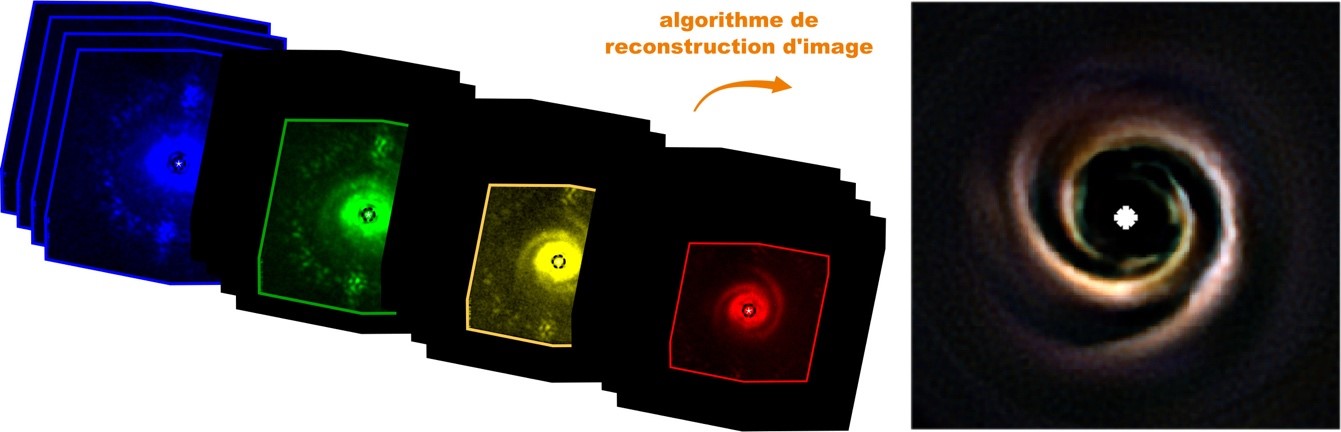
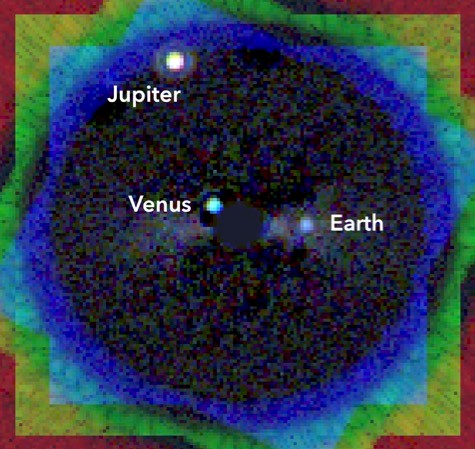
In three decades, more than 6,000 exoplanets have been discovered, but their diversity raises questions about the rarity of systems like ours and the existence of nearby habitable planets. Projects such as NASA’s Habitable Worlds Observatory and the PCS spectrograph of the future European ELT telescope aim to overcome these challenges by detecting exo-Earths using very high-contrast imaging, which is essential for analyzing their atmospheres and searching for biosignatures. A key challenge is the precise control of optical aberrations using deformable mirrors to create dark holes where starlight is suppressed to reveal very faint planets. A key difficulty is maintaining these dark zones over broad spectral bands, which is essential for performing atmospheric spectroscopy and detecting biosignatures. The main innovation of this project is to combine three “dark-hole” techniques, developed in French laboratories, with innovative multispectral detectors, allowing simultaneous estimation of the wavefront at several wavelengths.
To develop
Our research
Technological maturity of three innovative dark-hole methods
- Study and characterization of techniques for creating and maintaining dark holes (Self-coherent Camera, Pair-Wise Probing, Zernike Wavefront sensing) in polychromatic light.
Three optical detector techniques for multispectral imaging
Preparation of applications
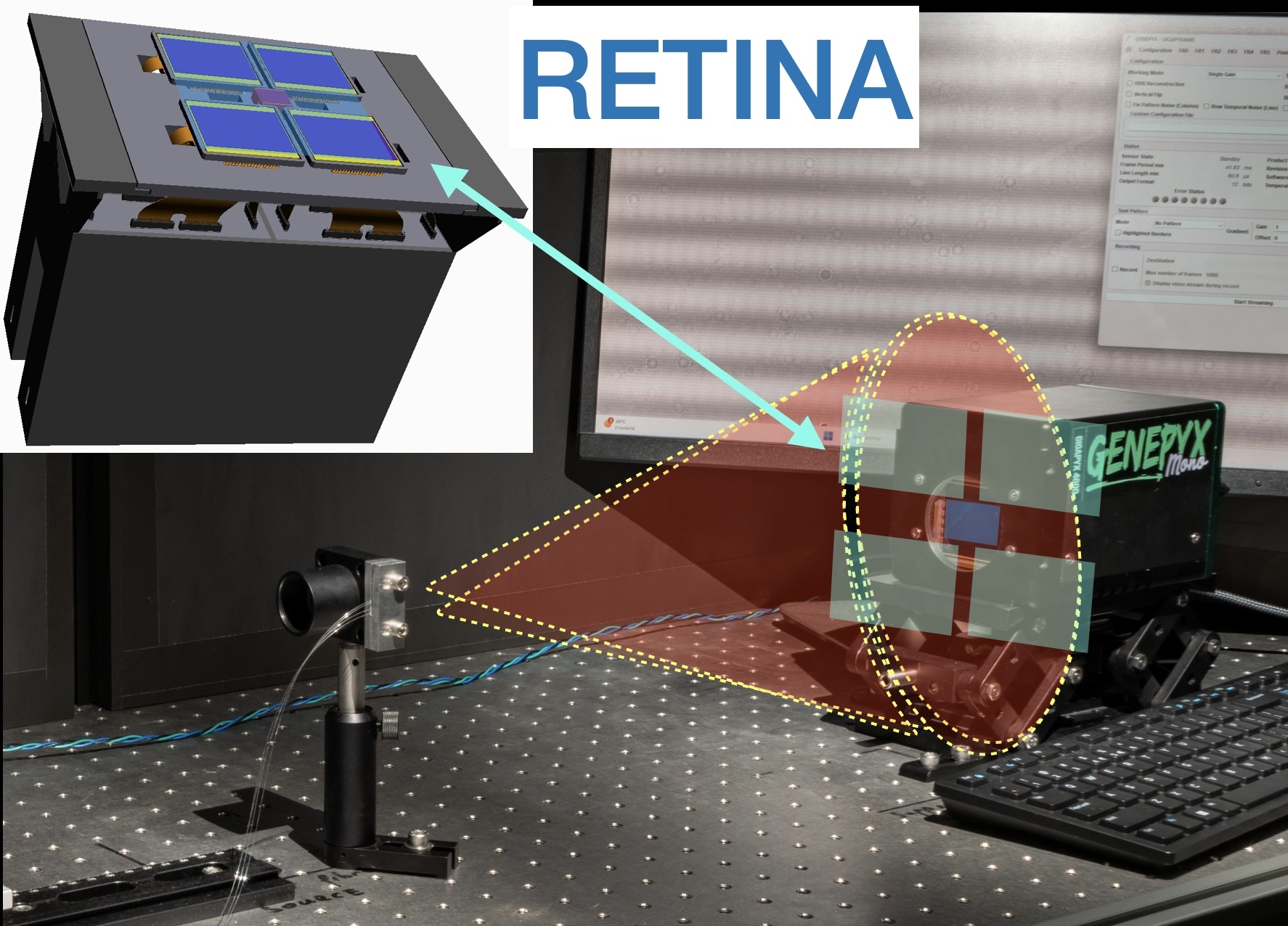
- Use of techniques that are both proven in astrophysics (integral field spectrographs) and widely used in industry (multispectral color filter mosaics). Finally, a prototype MKID (Microwave Kinetic Inductance Detectors) will be developed: these superconducting photon counting detectors represent a technology that is still at a low level of maturity but with strong potential for applications in quantum computing, biomedical imaging, and security control.
- Demonstration in the laboratory and under realistic conditions on a telescope. Comparative analysis of techniques for estimating aberrations and detecting polychromatic phenomena: performance and complementarity depending on the application.
The consortium
Led by LIRA (Paris Observatory – PSL / CNRS / Université Paris-Cité / Sorbonne Université) and hosted by the CNRS, AMINO includes researchers from LUX (Paris Observatory – PSL CNRS / Sorbonne Université), LAM (Aix Marseille Univ / CNRS / CNES) and the Lagrange laboratory (Côte d’Azur Observatory / CNRS / Université Côte d’Azur).