Researching Exoplanets Through Imaging for Narrow-angle Astrometry (RETINA)
Overview
- IPAG / UGA /CNRS : Fabien Malbet, Fabrice Pancher, Sébastien Soler, Hugo Rousset, Manon Lizzana
- Irfu / DAp CEA Saclay: Pierre-Olivier Lagage, Florence Ardellier, Jérôme Amiaux, Thibault Pichon, Jérôme Martignac, Eric Doumeyrou, Pierre-Antoine Frugier, Samuel Royanette
- Pyxalis : Julien Michelot, Paul Monsinjon, Pierre Muller, Benjamin Fertein, Sophie Caranhac
The RETINA project aims to develop a focal plane composed of large-format visible detectors with a total of around 1 billion pixels, enabling very high-precision differential astrometry. The objective is to detect and characterize Earth-mass exoplanets in the habitable zone of nearby solar-type stars, achieving an unprecedented astrometric precision of 0.3 microseconds of arc, corresponding to about ten micro-pixels. This project is part of the preparation for future space missions, as part of the High Resolution Imager (HRI) instrument of the Habitable Worlds Observatory (HWO/NASA) or the Theia mission project (ESA), by increasing the technology readiness level (TRL) of very large format CMOS detectors from TRL 3 to TRL 5 by 2030 for space missions and providing a TRL 3 imager based on CMOS detectors.
To develop
Our research
The RETINA project aims to develop key technologies for detecting the astrometric signal of Earth-like exoplanets around the closest F, G, and K stars, focusing on three main areas:
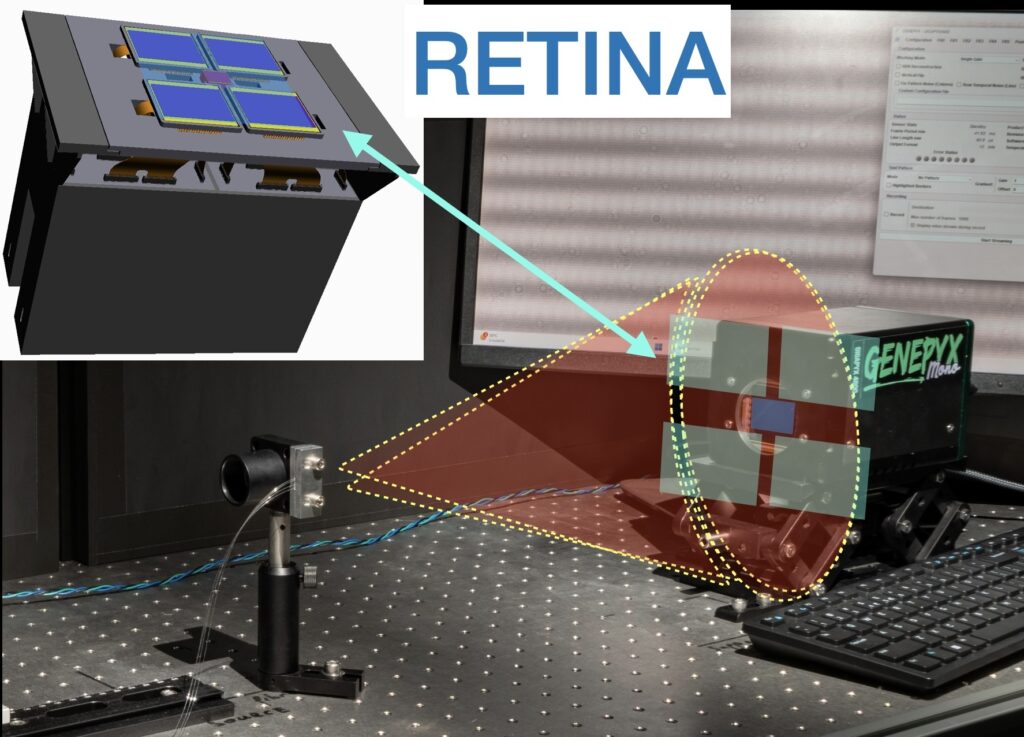
- the development of CMOS detectors for astrophysics applications through the design and qualification of very large format CMOS sensors (typically over 220 million pixels) equipped with fast electrical interface links (>800 Mb/s/link) compatible with space requirements (vibrations, vacuum, thermal control, mechanical alignment)
- High-precision calibration by developing a calibration method using Young’s fringes projected onto the focal plane to measure the geometry and intra-pixel response of the detectors.
- Integration and validation of the focal plane assembly through tests in a representative environment (vacuum thermal chamber) to validate the required centroid accuracy (~10⁻⁵ pixel).
Key components of new technologies:
- Very large format CMOS detectors: 220 MP sensors with a pixel pitch of 4.4 µm and a thermomechanical architecture suitable for space applications.
- Calibration system: based on the projection of interferometric fringes to measure geometric and intra-pixel variations at the micro-pixel scale (Crouzier et al. 2016). The system will be developed taking into account spatial requirements.
- Reading electronics: development of proximity electronics to control detectors, taking into account design rules for future space instruments.
- INTRAPIX platform: adaptation of interfaces applied to RETINA, a cryogenic test bench unique in Europe (CEA) dedicated to characterizing the intra-pixel responses of detectors.
The consortium
Université Grenoble Alpes / CNRS / IPAG, CEA Saclay / Irfu / Dap, Pyxalis
More projects